HYPERCAR-X
Parametric electric hypercar · concept program

HYPERCAR-X

1,100 kW quad-motor platform. Modelled, textured and animated in Blender, simulated in Python, drivable in your browser and on Android.

At a glance

Variant C · Electric Hypercar

Every number below comes from the parametric Python model and is regenerated by CI on each push.

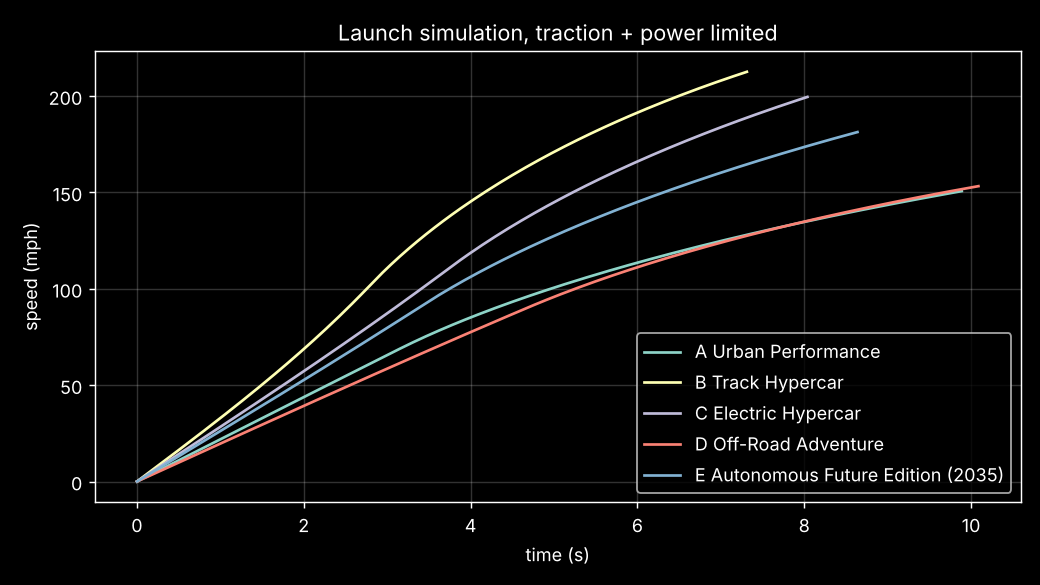
2.10 s0-60 mph
8.07 s¼ mile @ 200 mph
343 km/hTop speed (motor-rpm limited)
1,297 kgMass with 2 occupants
1.86 gLateral grip @ 250 km/h
27.6 m60-0 mph
757 kmRange @ 100 km/h
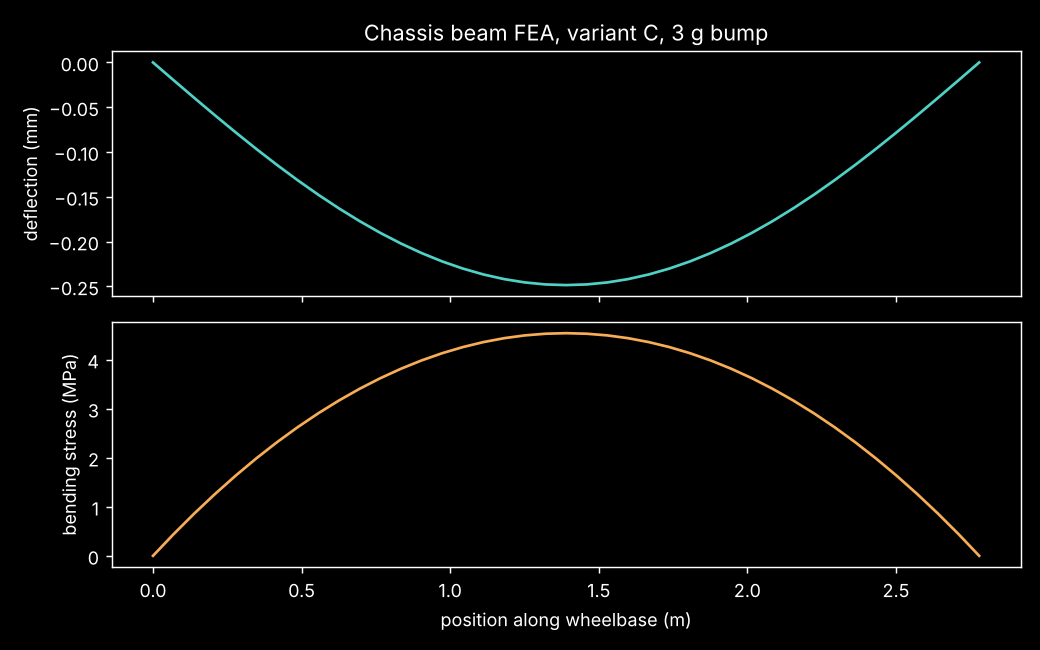
45.9 kN·m/°Tub torsional stiffness
Animation

Launch, brake, turn-in

300-frame rigged animation: rear squat on launch, nose dive and air-brake wing under braking, steering and body roll, tracked by a depth-of-field camera.

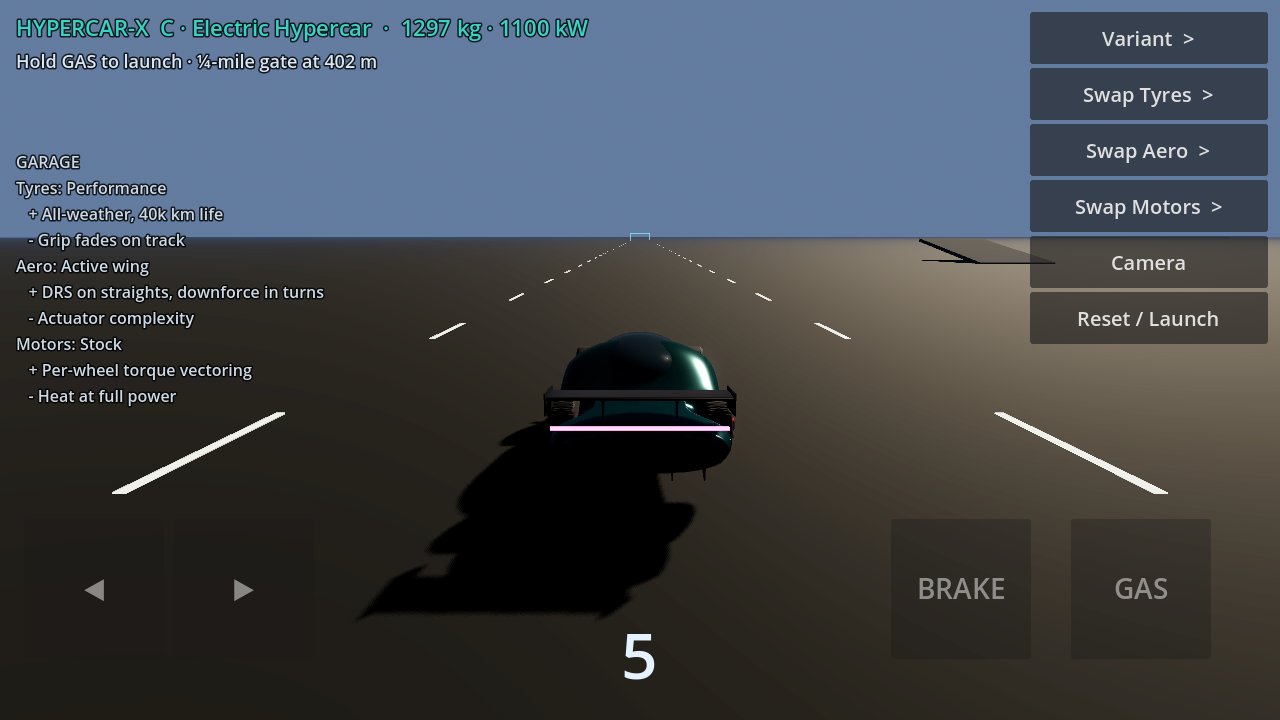
HYPERCAR-X Godot app on the drag strip with touch controls and garage
Godot 4.3 app · Android & Windows

Drive it on your phone

Uses the Blender-baked model with VehicleBody3D physics fed by the engineering model. In-app it does 0-60 in 2.5 s, the ¼ mile in 8.35 s and tops out at 343 km/h, against the model's 2.10 s, 8.07 s and 343 km/h. Touch pads, a garage with pros and cons for every part, a ¼-mile gate, slalom, handling ring and jump ramp.

Easy access

Downloads & links

Apps are rebuilt automatically by GitHub Actions whenever the Godot project changes.

🏎️

Browser simulator

Three.js, garage with swappable parts, five variants, works on phones.

📱

Android APK

Godot 4.3 app with touch controls. Open it on your phone and allow "install unknown apps".

🖥️

Windows app

Unzip and run HypercarX.exe. Keyboard: WASD or arrow keys.

📊

Engineering presentation

Animated 17-slide review: physics, FEA, materials, variants, risks.

🧊

Blender file

Rigged, animated model with procedural materials (Blender 5.2).

📦

GLB model

3.7 MB with baked diffuse, roughness and normal maps. Ready for game engines.

🎨

Baked textures

15 PBR maps: paint, carbon, tyre, rim, brake disc.

💻

Source code

Python model, tests, Godot project, simulator, CI workflows.

One parameter table, five cars

Variant comparison

Change any value in params.json and mass, CG, aero, launch, braking, suspension, FEA, range and cost all recompute.

MetricA UrbanB TrackC ElectricD Off-RoadE Auto 2035
Mass (kg)12941139129715201344
Power (kW)45012501100620800
0-60 mph (s)2.741.772.103.082.28
Quarter mile (s)9.937.358.0710.128.65
60-0 mph (m)36.322.927.640.030.1
Lateral g @ 250 km/h1.123.201.860.951.57
Range @ 100 km/h (km)6243927575091055
Ride frequency (Hz)1.803.012.331.422.29
Est. BOM (USD)156k244k243k175k282k
Launch simulation chartChassis FEA chart
Garage

Swappable parts: pros & cons

Every option is a trade-off. Try them live in the simulator or the app.

Wheels
21" carbon −18 kg unsprung, sharper response · $22k, cracks on kerbs
18" rally soaks up rough roads · +22 kg, less grip
Tyres
Semi-slick +15% grip · unsafe in rain, 8k km life
Eco low-RR +8–10% range · longer braking
Aero
Track pack 2.5× downforce · more drag, less range
No wing lowest drag · rear goes light at speed
Motors
Quad 1450 kW sub-2 s 0-60 potential · traction limited, thermal derate
Dual 600 kW −48 kg, cheaper · no per-wheel torque vectoring
Battery
80 kWh LFP −90 kg, long cycle life · −25% range
130 kWh solid-state lighter and longer range · not production-ready
Brakes
Carbon-ceramic fade-free · $15k to replace
Cast iron cheap, strong cold bite · +20 kg unsprung, fades